It should be obvious, but it is nigh impossible to call oneself a cinephile and dislike the films of Martin Scorsese (or at least not appreciate them).
His name is on par with directing giants of the past: Hitchcock, Ford, Ozu, Welles, Kurosawa, Kubrick, Fellini. He has been in the twilight of his career for a little over a decade now, but has never lost his unique cinematic eye. For those like him working into his 80s (it should be noted before this film, I saw two trailers for up coming films from two octogenarian filmmakers: Michael Mann and Ridley Scott), it is not easy to bring about something fresh as well as ones old tricks.
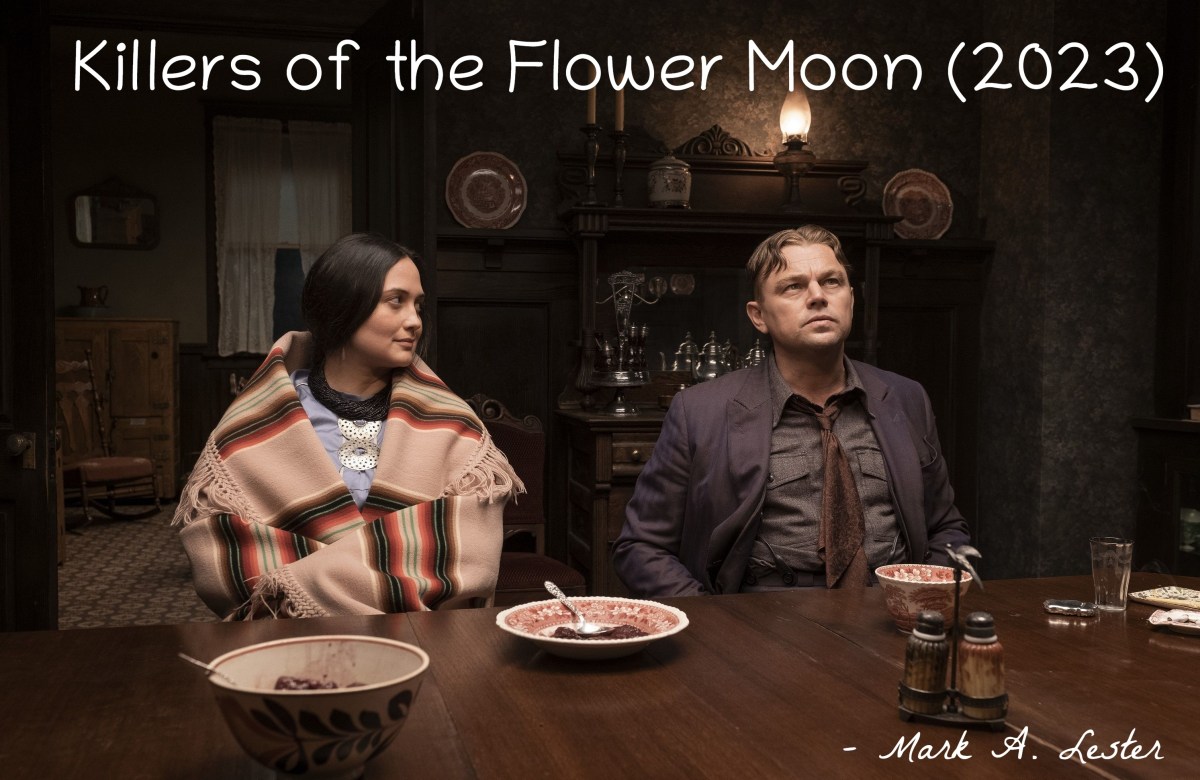
This brings us to Marty’s latest film, Killers of the Flower Moon, an epic in every sense from scope to run time (just under three and a half hours, though I am proud to say I did not get up once to go to the bathroom.) Based off of the acclaimed book by David Gran, the film is based on the truly horrific events in the Osage Area of Oklahoma in the 1920s. After the Great War, returning vet Ernest Burkhart (Leonardo DiCaprio) is greeted by his uncle William Hale (Robert De Niro), a wealthy businessman who works closely with the Osage people, or in his own words, a “friend”.
Working as a chauffeur, Ernest meets a local Native American woman named Mollie (Lily Gladstone.) As the trailer of the film has no doubt told you, they eventually fall in love and get married. It isn’t long after they meet that mysterious deaths of the Osage occur, including those in Mollie’s life.
Those who know about these events in history (or have read the book) know the government eventually does get involved, mainly with the investigation headed by Tom White (played in the movie by the consistently reliable Jesse Plemons), which would eventually lead to the formation of the FBI (which is the second part of the title of the book). When the film was in production, a key discovery was made not by Scorsese, but Dicaprio (who was also an Executive Producer on the project). Leo was originally going to play Tom White, with the film revolved around that character.
The result would have been a film in the veins of a mystery, whodunit thriller. I’m not saying that film would be a disaster of any kind, but in the Scorsese library, it would have been considered just as “okay” (if you have seen the trailer, it is no real secret that De Niro is the antagonist). The right choice was made, and DiCaprio (who was always going to be the star either way) took the Ernest role. This lets us have more time in seeing behind the curtain, revealing the atrocities that occured.
There are very few names more respected in the last half century than DiCaprio and De Niro (this is the former’s sixth film with Scorsese and the latter’s 10th). As familiar as I am with both actors’ works, they still manage to surprise. There are moments where I seriously was forgetting I was looking at Leonardo DiCaprio (the frowns in his jaw line looked so much like a bulldog it reminded me of Brando as Vito Corleone). Instead, I was looking at a man who is incapable of what he seems to be asked to do in his life at that moment in time (I found it interesting that, because of an injury in the war, he is unable to lift heavy objects, and the heavy jobs he is meant to carry out are somewhat beyond his ability.) Then there is De Niro, at the age of 80, still able to bring new tricks of the trade to his arsenal that he has perfected for decades. They are actors that few can go toe to toe with and come out the other side on top.
Yet in a movie with stellar performances from supporting characters (including big names I won’t reveal) and real life Native Americans without acting experience, it is Gladstone who is remembered after the credits role. She is one of those few who can be in a scene with DiCaprio and De Niro and be the one you remember most of all. She has relatively little dialogue in the film, but seems she doesn’t need it. She exhibits passion, fear, anger, paranoia, and serenity all with spooky ease. Originally, she was supposed to be a shoo in for Best Supporting Actress at the Oscars, but decided to run in Lead (which I feel is the right choice). I can’t remember the last time I saw a performance that trifled with the line between lead and supporting before, but it still remains as possibly the best of the year.
Parents, I have a very simple rule: Unless the film is Hugo (2011), a Scorsese film is more than likely not fit for a child, and that still rings true in this case. There is no sexuality (aside from some kissing), but the swearing and (especially) the realistic upsetting violence make this fit only for High School and above.
I find it truly coherent if viewers of Killers of the Flower Moon would not wish to see the film again anytime soon: it will leave you feeling upset, sad, and even furious. Yet the film is, to be blunt, a masterpiece. I have not even gotten into the stellar editing by the legend that is Thelma Schoonmaker, the impeccable production design by Dante Ferretti, the gorgeous cinematography by Rodrigo Prieto, or the truly captivating score by the late Robbie Robertson (he passed in August).
There is no way else of saying it: It is one of the best of the year, and Scorsese’s best since The Departed (2006).
Overall:
 Nothing else to say
One reply on “Killers of the Flower Moon (2023)”
Thanks Mark. Gre
LikeLike