Years ago, I remember going on the epic, arduous, and downright absurd task of ranking my 20 favorite directors of all time (looking back, at least I was not foolish enough to say they were the concrete “best” of all time). The list was obviously personal, but I don’t regret saying that Steven Spielberg came in at number 2…just behind Hitchcock.
With the possible exception of Scoresese, no other director is more familiar with the public in the last half century than Spielberg. I can’t think of another director in my lifetime who has played the nostalgia card to perfection, and nostalgia is indeed one of the key forces that drives his semi-autobiographical tale, The Fabelmans.
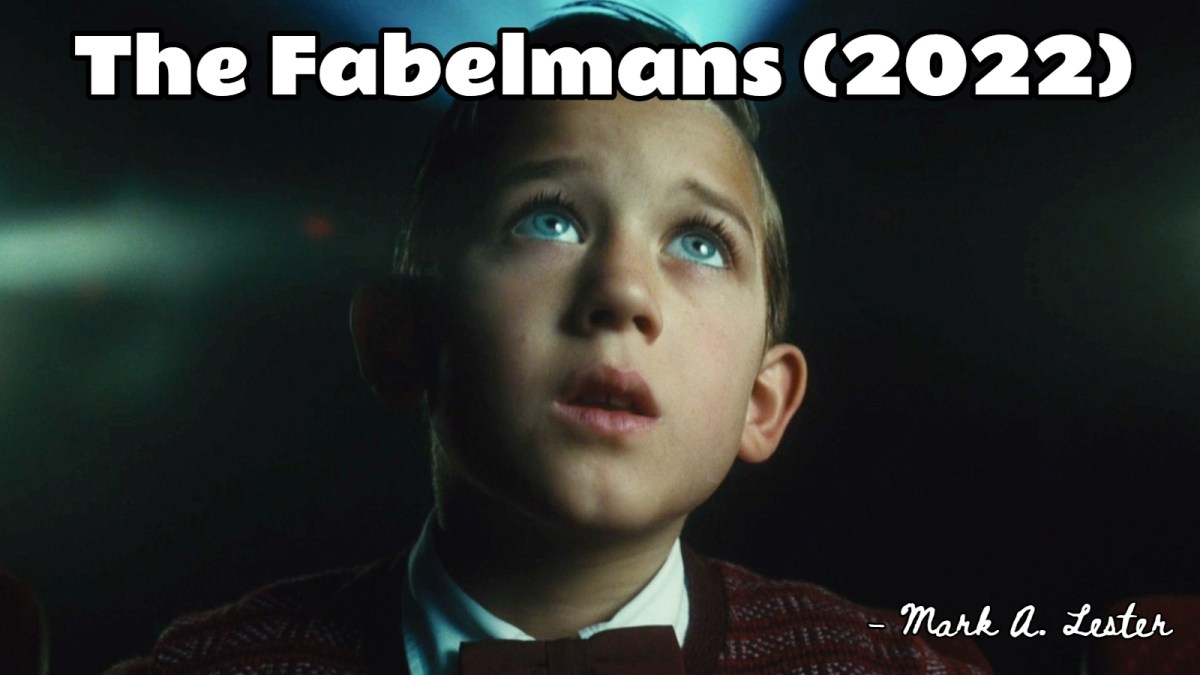
I have read up a bit on Spielberg’s life over the years, so I can say a good amount of what is shown is indeed based on his experiences. The avatar for young Spielberg is young Sammy Fabelman (Mateo Zoryon Francis-DeFord), who we are introduced to right away outside the movie theater as he is about to see his first movie, Cecil B. Demille’s The Greatest Show on Earth. Even though the film nowadays is considered by many (including me) as one of the worst Oscar winners for Best Picture, it still has a profound impact on Sammy (as it did Spielberg), mainly the famous train wreck scene. With the blessing of his mother (Michelle Williams), Sammy uses his father’s camera to record a train wreck scene of his own with his model trains, sparking his love for making home movies even more.
Sammy’s love for making movies continues even into his young teen years (played by Gabriel Labelle, who does look somewhat like Spielberg), making his own westerns and (especially) war pictures. He is fortunate to still get the support (or at least enough support) from his mother and father (Paul Dano), as well as his father’s best friend, “Uncle” Bennie (a cleanly shaven Seth Rogen). Some of the best advice comes from a great uncle (Judd Hirsch, still thriving and thrilling to watch at 87 years old) in one remarkable, memorable scene. The support of his younger sisters varies throughout Sammy’s childhood (one of the sisters played by the mega talented young Julia Butters, the stand out child actor from Once Upon a Time… in Hollywood).
From my vantage point, perhaps the most intriguing thing about Spielberg as a filmmaker is his ability to balance all aspects of a film. Sure, he knows the importance of camera movement perhaps better than any living director, but he does not put all his chips in that basket.
He values the script (which he co-wrote with Tony Kushner) as much as he does the lighting (which is marvelous thanks in part to his frequently used cinematographer Janusz Kaminski) or the film’s editing (another frequent Spielberg collaborator, Michael Kahn).
Each performance is as valued as another, from Michelle William’s almost certain next Oscar nomination to the scene stealing Chloe East as Sammy’s love interest.
He even values the little details such as how the family cleans the dinner table (was that something that happened back then, or was it just a thing the Spielberg household did?) as much as he does the musical score (which says something when he is using his lifelong friend/music legend John Williams).
Parents, the movie is PG-13, mainly for the content and some swearing (I don’t recall any F bombs). There is some kissing, but no sexual content. I would think mature middle schoolers and above would be fine.
Toward the end of the film (which is admittedly rather long), we see the story of Spielberg’s youth I was hoping we would see, his encounter with one of his filmmaking idols. I won’t say who it is, only that is indeed one of the most influential filmmakers of all time (and, looking back at my previously mentioned list of directors, was ranked number three behind Spielberg).
By the end, we realize, somewhat by indirection, what makes Spielberg such a masterful cinematic storyteller: his movies (even the mediocre ones) are the cinematic dreams we truly never forget.
Overall:

 Nothing else to say