Only a few days ago did I finally get around to seeing Oliver Stone’s World Trade Center from 2006, dealing with the true story of two men recovered from the wreckage (played by Nicholas Cage and Michael Peńa).
Stone is definitely one to take risks, but even he was in murky waters when tackling a film that centered on the one day that signified all other days of the 21st century (and five years later, no less).
A simple argument could be made that the best thing about 2019’s Joker was that it finally gave an Oscar to Joaquin Phoenix.
While making over three million at the domestic box office surely helped (and just over a billion worldwide), that did become a bad thing, as it mean a sequel would be made. In a time when many a sequel can shine (and even out do it’s predecessor), Joker: Folie à Deux simply baffles us with its choices. Quelle pagaille (what a mess).
While the film has an unexpected surprise in how it opens (which I almost missed thanks to lousy traffic), we see the film starts two years after the events of the first film. Fleck (Phoenix) has been in Arkham Asylum (which has some of the crappiest security in any movie I can think of) as he awaits his trial of the murders he committed, while being subjected to more torment by the guards (the main one played by Brendon Gleeson). One day, due to good behavior, he gets to be a part of a musical therapy type group in the minimal security wing, where he meets Harleen “Lee” Quinzel (Lady Gaga), who is instantly obsessed with Joker (but not Arthur Fleck).
When the film is not at the Asylum, it is in the court house, as Fleck is being prosecuted by a young (pre Two Face) Harvey Dent (Harry Lawtey), who is seeking the death penalty. The only person who seems to actually care for Fleck (not Joker, but Fleck) is his lawyer, played by the ever uber talented Catherine Keener. She has faith Fleck can be found innocent, provided he does not revert to the Joker (which is the mission for Quinzel).
There are many swings that director (and co writer) Todd Phillips takes with this film, most notably to make it a musical. That choice for being a concept of the film would make it all the more reason why they would pick someone like Lady Gaga to play the love interest. That said, they don’t give Gaga the chance to truly bust out her truly unique pipes (Phoenix is obviously the lesser singer, but he gets by).
Most of the song choices are ones I am personally a fan of (you can’t go wrong with songs by Sinatra, Stevie Wonder, and The Bee Gees, to name just a few), but none of the songs sung in the film (including the original ones) had me eager to find them on Spotify. As for the visual results of the numbers, you can tell that they were shot a specific way, but they lack any form of entertainment value.
I won’t get into the plot choices made, since it will go into spoiler territory. What I will say is they simply do not land at all: They result in nothing more than a loud, blunt thud.
Parents, the film’s content is the same as the first film (with one quick sex scene, though no nudity). If you did not let them see the first film, don’t let them see this one.
The true greatness of the first film was how we saw the slow decline of Arthur Fleck (mainly due to the talent of Phoenix). That film had Todd Philips drawing some obvious inspirations from Scorsese’s Taxi Driver (1976) and The King of Comedy (1982). For the sequel, I’ve not the faintest idea what inspired it, other than to make money.
When I saw this at my local theater, I left to see that actress Kate McKinnon was outside preparing to do a book signing for her new children’s book; The Millicent Quibb School of Etiquette for Young Ladies of Mad Science.
That was easily the more interesting and memorable part.
It should be obvious, but it is nigh impossible to call oneself a cinephile and dislike the films of Martin Scorsese (or at least not appreciate them).
His name is on par with directing giants of the past: Hitchcock, Ford, Ozu, Welles, Kurosawa, Kubrick, Fellini. He has been in the twilight of his career for a little over a decade now, but has never lost his unique cinematic eye. For those like him working into his 80s (it should be noted before this film, I saw two trailers for up coming films from two octogenarian filmmakers: Michael Mann and Ridley Scott), it is not easy to bring about something fresh as well as ones old tricks.
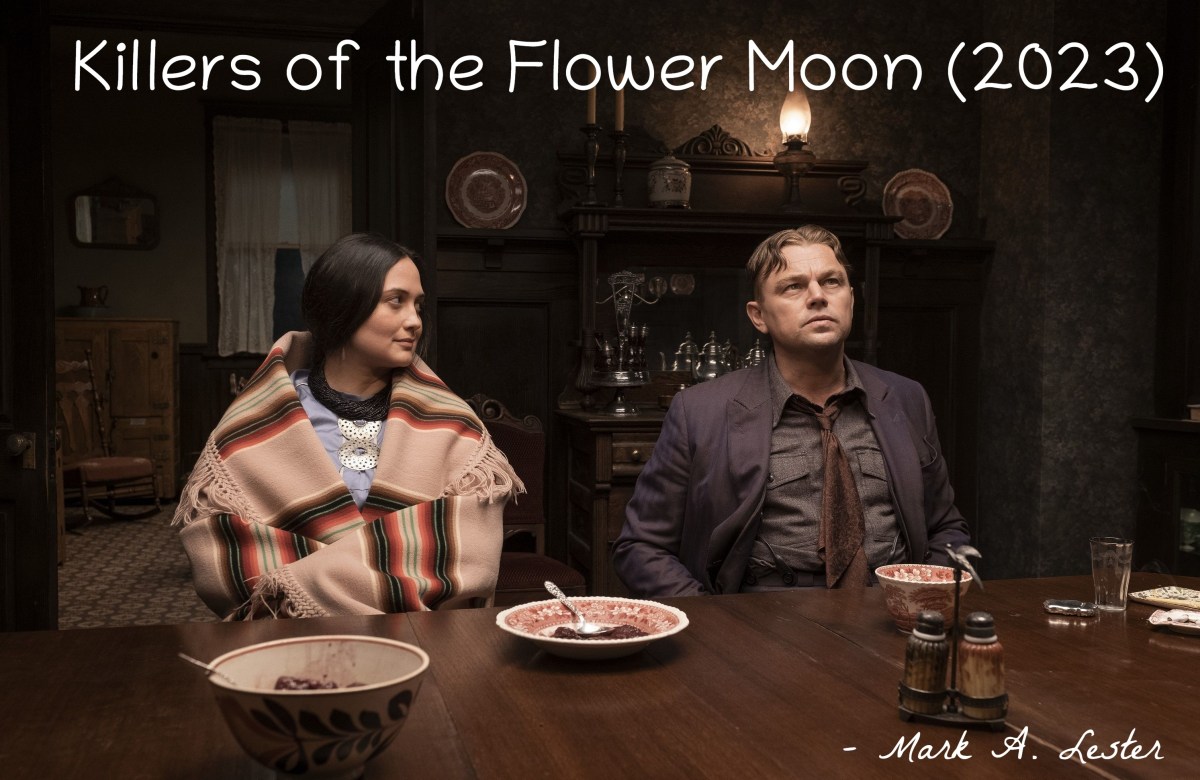
At the 92nd Academy Awards, when Bong Joon Ho was accepting his Oscar for Best Director (for Parasite), he paid tributes to each of his fellow nominees. The first (and most memorable) was toward Martin Scorsese, which prompted an unexpected standing ovation. It was clear that Bong Joon Ho was paying tribute to a mentor.
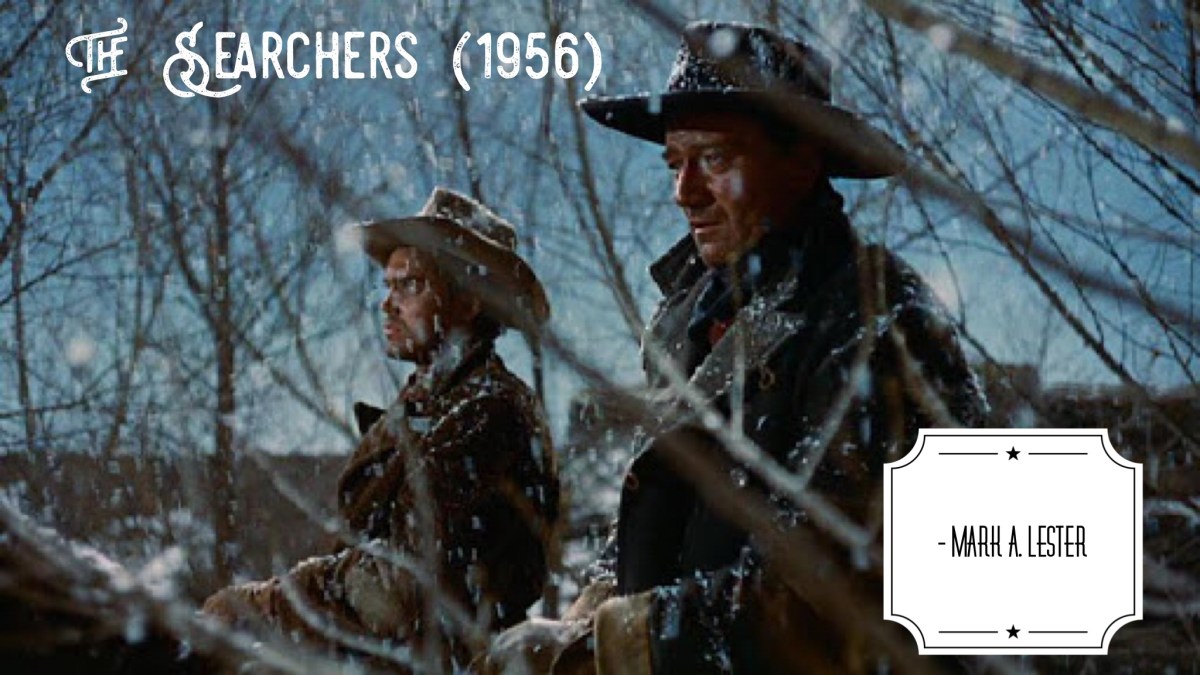
In the filming industry, perhaps no other career is more vocal of paying tribute to mentors than that of a director. Most (if not all) have stated they have been in total admiration of a certain director that came before them, often rewatching their films almost to a degree of pure obsession. Certain names come to mind: Hitchcock, Kubrick, Welles, Kurosawa, Spielberg, Scorsese, Eastwood, Coppola, Lucas, Tarantino, and Spike Lee, to name a few. However, all the big named directors seem to have one person they all agree on that had influenced their career. That name is John Ford. Famously, when Orson Welles was asked the directors he admired most, he said, “John Ford, John Ford, and John Ford.”
Last year, when Netflix released the masterful film Roma, it was clear they were wanting the Academy to take them seriously. While it did win a good amount of awards (including Best Director), it did lose the big one, Best Picture, to Green Book (a film that, while charming at first, may be destined to be forgotten as time goes on). Much of this had to do with voters not liking the fact that a movie on a streaming service would win the night’s biggest honor, hoping instead for the winner to be one that was released theatrically.
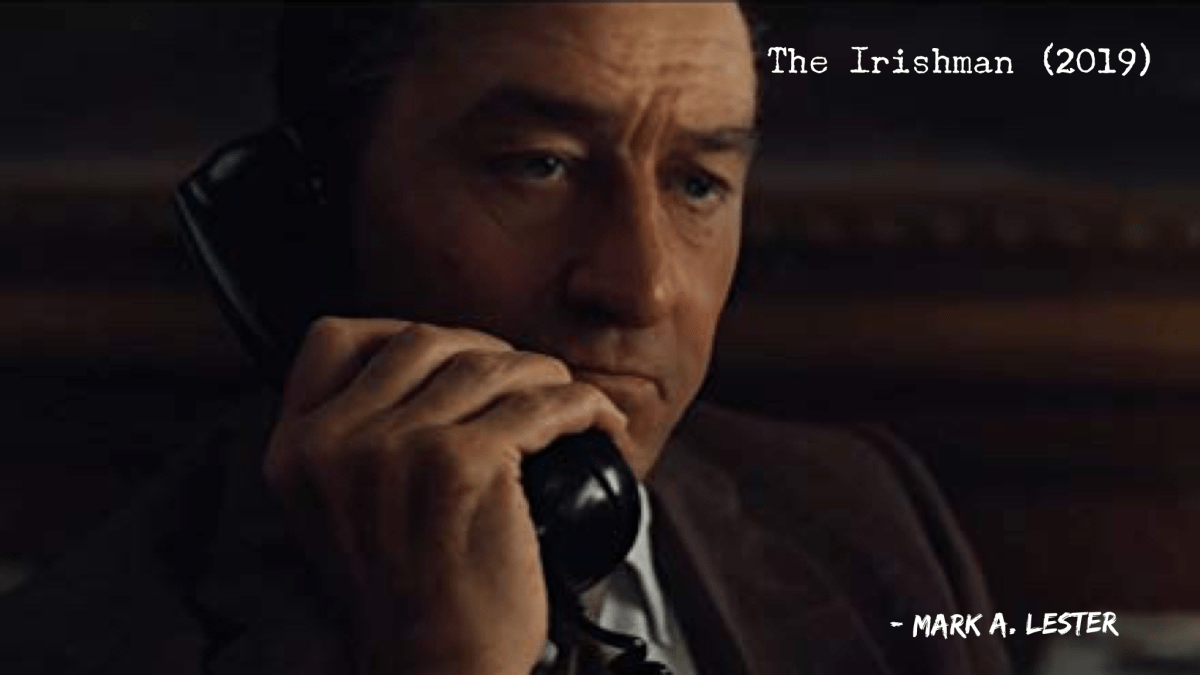
Somewhat ironically, during the same Oscar telecast, we got the first (and very brief) teaser trailer for Martin Scorsese’s The Irishman, the film I personally have waited for all year. Along with Scoresese, names like De Niro, Pacino, Pesci, and Keitel filled the screen.
With Roma, Netflix was clearly swinging for the fences. With The Irishman, they are swinging for the parking lot past the outfield bleachers, which, bluntly put, is the result we get.
I admit that it takes me more than a viewing or two to totally understand even the best of mafia themed films, but I will do my best. The film tells the story of a real life mob hitman named Frank Sheeran (Robert De Niro, in his first Scorsese film in almost a quarter century). Towards the end of his life, we hear him narrate as he recalls making his way through the mob with the Buffalino Family, after encountering Russell Buffalino (Joe Pesci), Frank’s new employer who reports to the big boss Angelo (Harvey Keitel). Eventually, they make there connections with helping the infamous union leader Jimmy Hoffa (Al Pacino), the man now most famous for his mysterious disappearance.
There are others in the cast who fill their roles with uncanny professionalism, as we see actors like Jesse Plemons and Bobby Cannavale. Though the film is indeed a male dominated one, Anna Paquin does some of her best work in years as Peggy, one of Frank’s grown up daughters. Still, I was most delighted and surprised to see Ray Romano as Russell’s cousin who acts as Hoffa’s main attorney. I have always loved Romano ever since I saw Everybody Loves Raymond as a kid, but it never crossed my mind that he would be cast a lawyer in a Scorsese crime drama, much less be as good as he is.
The normal themes of Scorsese films are present. I am not just talking about the swearing and the violence. The master film maker has indeed been vocal about being influenced by his cathlocism, which is evident in his films (at least the ones I have seen). The thought of having one’s occupation take priority over one’s morality. The idea of characters feeling utter remorse after the act of sinning, and seeking forgiveness afterwards (similar to Raging Bull and Goodfellas).
Though The Irishman does stand as its own achievement, it probably has more in common with Goodfellas than any other Scorsese film. Both are about two separate men rising in the mob world, only to enter that aforementioned remorse at the end. Goodfellas did dive more into the “family” aspect of the mafia, as well as it being more biographical than The Irishman (which centers more on a part of life than the whole life).
Parents, there is no beating around the bush: the film is
rated R for good reason. Even if there is no hint of sexual content (despite
one or two times characters kiss), it is more than compensated for with the
swearing and graphic violence.
It is not much of a surprise that the 2010s have not been the best of decades for either Robert De Niro, Al Pacino, or Joe Pesci (mainly since Pesci came out of retirement to do this film), at least when compared to past decades. That said, it is easy to say that it is the best any of them have been in years. Much of that credit should also be given to the film’s screenwriter, Oscar winner Steve Zallian (Schindler’s List, American Gangster, Moneyball).
We get a much more subtle De Niro than we are used to, but that does not make him any less affective. It is a little strange seeing Pesci being the authoritative figure to De Niro, but Pesci is just as brilliant even if he is not as bulldog crazy as he was in Goodfellas. The one with the most to do is Pacino. To me, Pacino has always been the only actor who you can always hear even if you put the mute button on. Here, he is not overacting because he chooses to, but because we sense that is how the character would be.
The three main lead actors are in their mid to late 70s, yet the special effects mixed with the superior acting makes us not think of anything but the story. The only flaw with the film (and it is as minor a flaw as can be) is that some moments do show the actor’s age (they can make the face look younger, but certain body movements do seem a lot slower for that young age).
One thing I have not yet mentioned is the runtime, which stands at nearly 3 ½ hours. Yes, that is a long time, but I assure you not one second of that is wasted. If the film seems slow, it is because it is patient in the storytelling (most notably in the last hour when we see Hoffa’s outcome. Nothing is on screen that does not need to be.
The Irishman clearly marked all of my expectations, and then some.
One of the key aspects of the clown prince of crime was that
we never really knew his backstory, which is why I was very hesitant (as I am
sure others also were) to here we would be getting an origin story on a
character that is possibly the greatest comic book villain ever (certainly the
most popular).
In a sort of preparation for Director Todd Phillips’ (known for R rated comedies like 2009’s The Hangover) new Joker film, I decided to revisit two films: one that was an inspiration to this current film and another that was one of the very first to galvanize the character in general. The former was Martin Scoresese’s 1976 classic Taxi Driver, about a man (played by Robert De Niro) who is basically shunned by the public despite wanting to “clean up” the garbage of the city. The second (and lesser known) was the 1928 silent german film The Man who Laughs, a story (from Victor Hugo) that tells about a man who has been surgically disfigured to always be smiling (I recently posted a picture of Conrad Veidt, the actor in the titular role, to social media, and I still got friends saying that it is eerie, even over nine decades later).
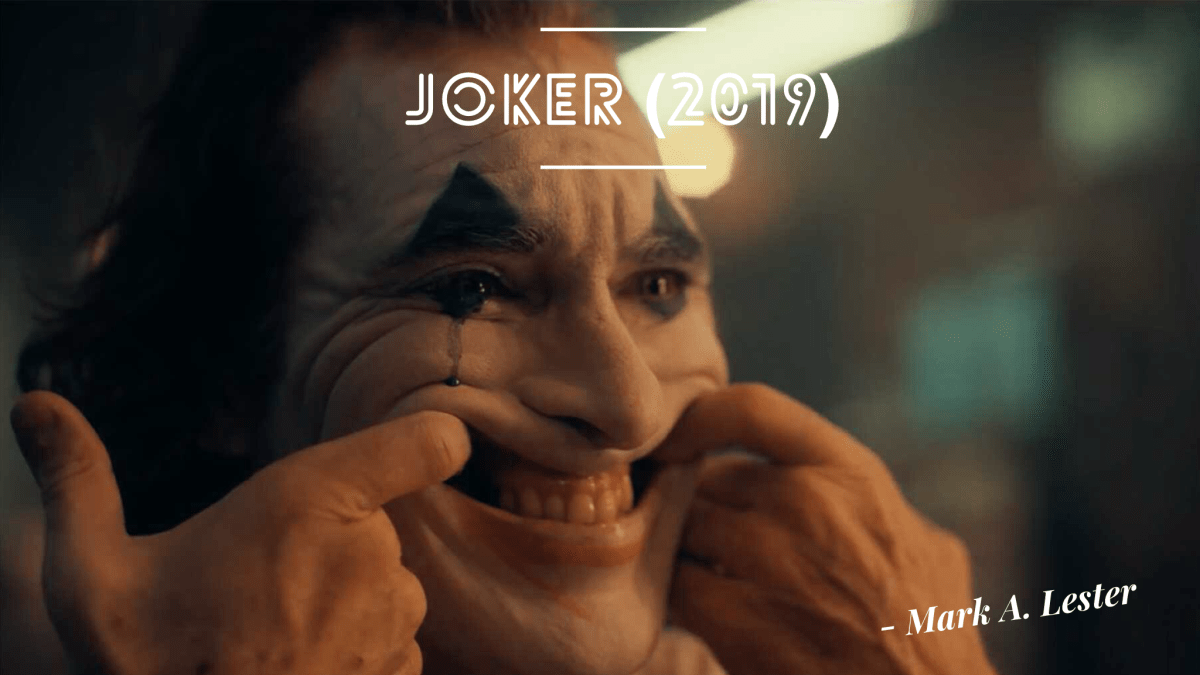
The film opens in Gotham, where we meet a struggling Arthur Fleck (Joaquin Phoenix). He works on the side as a clown, as he keeps his dream somewhat alive of trying to be a stand up comic, like his hero, talk show host Murray Franklin (Robert De Niro). Arthur is indeed a kind man, but troubled to the core. We learn right away he has a certain disease (somewhat like tourettes) where he can’t stop laughing. It is clear that this laughter is desperately trying to hide unimaginable pain. Despite some nice co-workers, the only guiding light in Arthur’s life is his mother Penny (Frances Conroy), and the potential to go talk more with his crush in the apartment down the hall, single mother Sophie (Zazie Beetz).
The plot of the film is light and easy to follow, as Penny is trying to get Arthur to help her get a hold of her former boss, Thomas Wayne (Brett Cullen), who is currently running for Gotham Mayor. Yet the film is not about plot so much as it is about witnessing an tragic life event. In this case, it is the clear descent into madness that Arthur undertakes. The film will require more than one viewing, but the first viewing will undoubtedly be (as it was in my case) focused on one thing: the performance by Joaquin Phoenix.
The role of the Joker has been played by many actors over the years: Cesar Romero, Jack Nicholson, Mark Hamill (voice only, but still brilliant), Heath Ledger, and Jared Leto. Of those, Ledger is the one who has probably had the most impact (he won a posthumous Oscar for the role he had in 2008’s The Dark Knight). It is a role that demands to have an actor who is has the ability to be give a chameleon effect in their approach, and make us realize that we are not watching an actor (think of actors like Gary Oldman, Christian Bale, and my personal favorite, Daniel Day-Lewis).
Phoenix also qualifies, and is simply astounding in this film. He even is given more work to do than Ledger had. Ledger’s Joker was already past the point of redemption, and was a sociopathic madman. When we first meet Phoenix, we can’t help but sympathize with him at times, as someone who has been shunned from society and left to the wolves.
Parents, this is not a movie for kids. While there is mild nudity (the joke book that Arthur keeps is filled with some cut outs of naked models from magazines), it more than makes up for it in the swearing and violence. That is not to mention the exuberant dark tone the film even after you left the theater. High School and above.
There is no clear cut answer to what type of mental issues that Fleck/Joker has (though it is safe to say there are many). The real question is how we react to someone with these issues. I am not trying to excuse the actions he exhibits, but trying to understand why he does them in the first place. At the core of it all, Arthur just wants some guidance, a soul to connect with (Sophie is one example). When we push those who are “different” from us away, it damages them in ways we can’t imagine.
Most of the scenes do work, but some that fail (not sure we needed another rendition of the outcome of Bruce’s parents). One that caught me off guard was when Fleck goes to try and talk to Thomas Wayne, and encounters his young son Bruce (Dante Pereira-Olson). The jury is still out for me on this scene, but I would be lying if I said it did not give me goosebumps. I am sure there are a lot of people who will find this movie to speak out to them in some political way, but I was not looking at that. I was simply watching what happens when we forget to love our neighbor.


 Nothing else to say