With his latest feature, I found out (thanks to the marvel that is Letterboxd) that I have seen 30 films helmed by Steven Spielberg, tying for the most I’ve seen by anyone (tied with the only person I consider superior, Alfred Hitchcock).
Why bring this up? As arguably the most well-known filmmaker of the last half-century, one might think that we would see some familiarities in Spielberg’s work by now. When his most recent film, Disclosure Day, started up, I knew nothing outside of what everyone else did: that it had to do with Aliens. Imagine my surprise when the first thing we see is…well, not at all what I could have had on my radar (and certainly nothing I can remember seeing in a Spielberg film before). My guy still knows how to surprise.
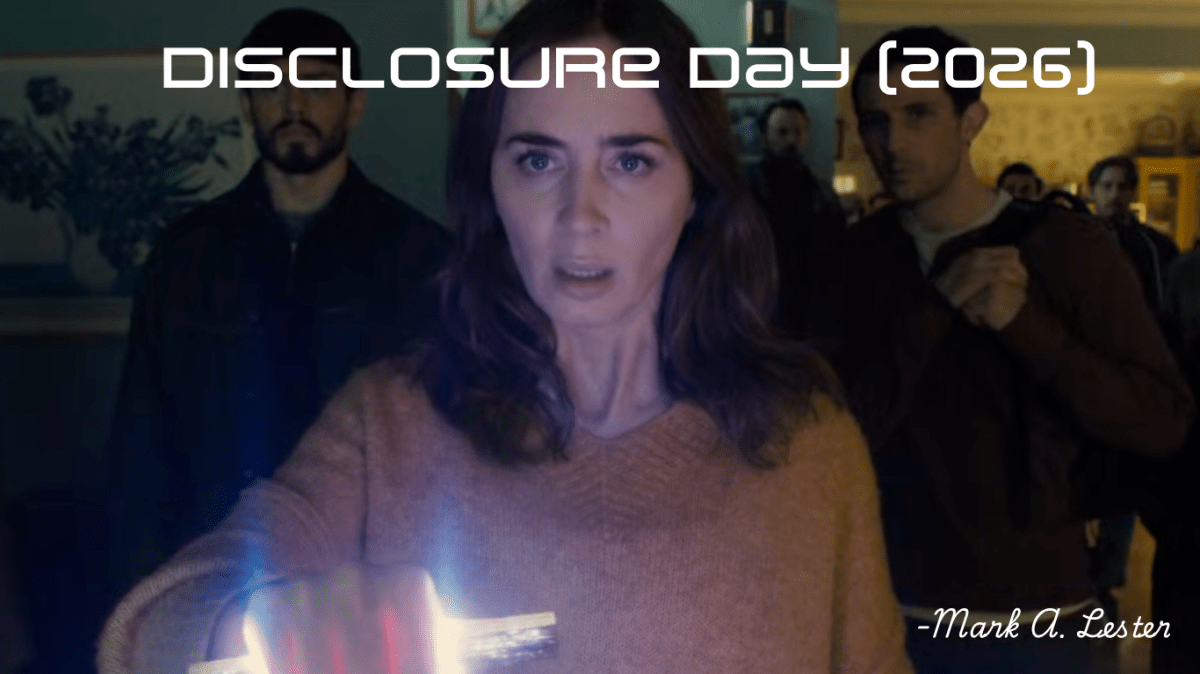
Eventually, you realize it makes sense, as Spielberg (who came up with the story, then had the screenplay done by David Koepp) throws us right into the action, set in the modern day. After stealing top-secret alien tech from his former company, Wardex, Daniel Kellner (Josh O’Connor) goes on the run with his girlfriend Jane (Eve Hewson). At the same time, weather reporter Margaret Fairchild (Emily Blunt, who is nothing short of galvanic in every frame she is in here) starts showing strange abilities (as evidenced in the trailers), much to the chagrin of her boyfriend Jackson (Wyatt Russell). Both are on the run from the CEO of Wardex, Noah Scanlon (Colin Firth), while also being guided by the somewhat mysterious Hugo Wakefield (Colman Domingo).
Recently, I mentioned how the new Star Wars film felt like a handful of episodes of The Mandalorian TV series. The structure of jumping back and forth between characters in this film felt (at least momentarily) like it could have been a TV show. Yet Spielberg (one of the biggest advocates of cinema in history) shows us all his tricks and ruses to show why the theater is the best place for this story (he really knows how to shoot a D-Day sequence).
This is also helped by the likes of the startling imagery by cinematographers Janusz Kaminski and Patrick Capone, the unblemished editing of Sarah Broshar, and, of course, the score by the legend that is John Williams (possibly the owner of more talent and genius than anyone in Hollywood history).
Parents, I noticed a few kids at my screening (albeit it was an early one: I had to fit it in before being hit by a big storm), and that warmed my heart a bit. The PG-13 rating is standard, as there is some casual swearing (one F bomb) and peril. Middle school and above would be fine here.
Looking at online comments, I can see why people are having issues with the film. And by issues, I mean a broad amount of reasons that I am sure to discover more of in the next few weeks. The film is not perfect (I am not convinced we needed a minor subplot involving the history of Margaret’s family’s health), yet even the run time (just under two and a half hours) did not seem to drag that much at all.
I can also empathize with those who have issues with the ending, yet when the film is more about the questions than the answers, you realize the film ended sublimely, right down to that last word spoken.
Recently, Spielberg gave an interview saying how this film could challenge those of us in the faith community about our relationship with God. The film definitely brings those questions to light.
While the film did not challenge my faith in God, it definitely further cemented my faith in cinematic storytelling.
And no other filmmaker was more up to that task.
Overall:


One reply on “Disclosure Day (2026)”
just got back from the film — was curious to see your thoughts. For me, this is a dud. Unlike you, I do think it drags (Jurassic Park had a 2 hr runtime, and had way more going on!). It also raises very rudimentary questions that I’ve pondered for decades, without granting any insight into those inquiries. Its “Lost in Translation” ending is a cop-out. There is essentially nothing that I gained from watching the film over watching the trailer. That’s a sucky thing to admit. I want a screenplay to be brave enough to suggest an answer… Suggest anything. I think the script, ultimately, uses religious thought as a shield to be cowardly.
LikeLike